Manual & Investor Brief

The full pitch + player manual — one document.

Everything in one place: the premise and market pitch, the complete how-to-play manual, the eight networks, and a technical "under the hood" section.

Accessibility — built in from day one

Cozy-frustration, never actual frustration.

Settings, one tap away

A menu on the map, in any room, in Passwordle and in Sweet-Talk opens a pause/Settings overlay — flip Reduce Motion, Fair Keyboard and Colour-blind, cycle Text Size, or jump back to the map. Every accessibility setting is fully touch-reachable; no keyboard required.

Text Size

Tap Aa on the map (or open Settings) to cycle Normal → Large → Huge. Every layout reflows to fit — nothing overflows, nothing clips — and your choice is remembered.

Reduce Motion

Removes screen shake, the particle fountain and the keyboard wobble — all the catharsis, none of the shake.

Fair Mode

Disables the autocorrect sabotage entirely. The joke never becomes a barrier.

Colour-blind

By design the game never relies on colour alone: signal carries a number and a label, clues carry a type tag.

First-run coaching

A friendly pointer hand-holds you through every level until you crack it — tap the next note, talk to whoever's hiding a clue, open the board, type the answer — and each level's coach bows out the moment that network falls.
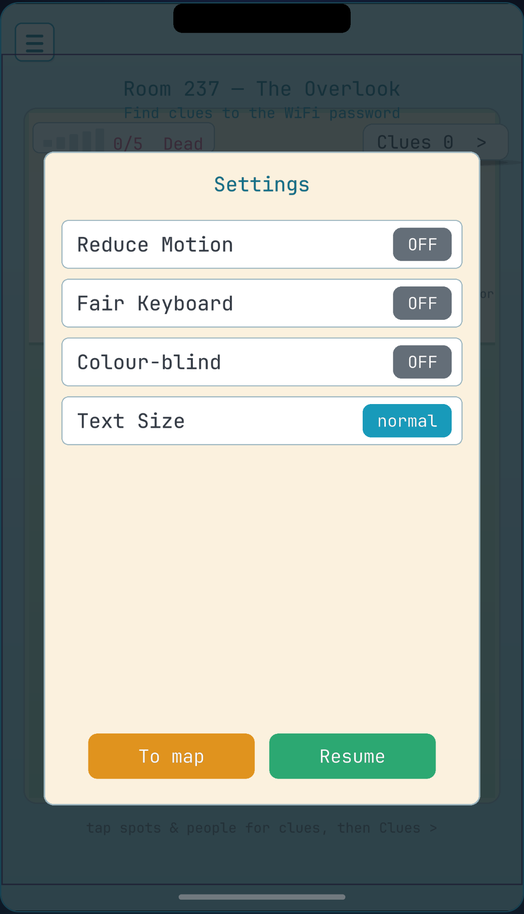
The in-game Settings overlay: touch toggles for Reduce Motion, Fair Keyboard, Colour-blind and Text Size, plus To map and Resume.
The ☰ Settings overlay — every accessibility option, one tap away on a phone.
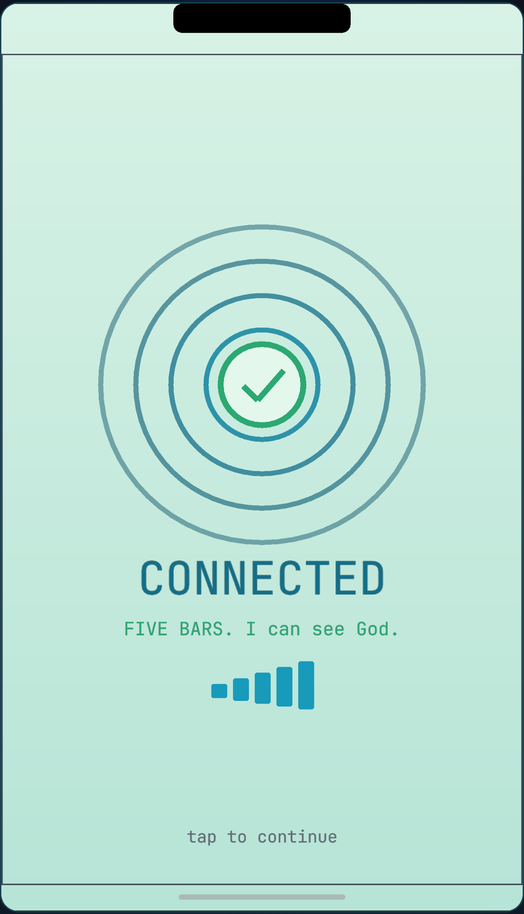
The same victory in Reduce-Motion — all the payoff, none of the particles or shake.
Under the Hood

Built to ship — and machine-verified.

Everything is data

Levels, rooms, puzzles, dialogue and every line of text are JSON loaded at runtime. The 8-level campaign was built without touching the engine — new levels are content, not code.

115 automated checks

A headless harness drives the real binary with scripted input and inspects a full JSON state log of every frame — proving every level is winnable, that clues never lace themselves, that a signal-gated clue really is unreachable from a dead zone, and that running out of patience never soft-locks. On every change, with no display.

Portable by design

raylib 6 in C: a 120 Hz fixed-step loop, a scene stack, one semantic input layer that already takes both mouse and touch, and a platform seam isolating every OS-specific line for iOS.

Plays in the browser — and remembers

The whole game compiles to WebAssembly and runs with no install, crisp on retina phones (HiDPI). Your progress saves right in the browser and survives a reload — saves migrate forward across updates and self-recover from a backup.

The risky, unproven part of a game — is the core loop actually fun, and does it hold together? — is already built, playable, and tested. What remains is content and polish.